Nursing Diagnosis and Nursing Intervention

Imbalanced Nutrition Less Than Body Requirements related to Loss of Appetite

Imbalanced Nutrition Less Than Body Requirements related to Loss of Appetite
Nursing Care Plan

Imbalanced Nutrition Less Than Body Requirements related to loss of appetite

Goal:
  • Showed good nutritional status.

Expected outcomes are:
  • Tolerance to dietary needs.
  • Retain lean body mass and body weight within normal limits.
  • Laboratory values ​​within normal limits.
  • Reported adequacy of energy levels.
Imbalanced Nutrition Less Than Body Requirements related to loss of appetite - Intervention:
Independent:
  • Create a meal plan with the patient, to put in a feeding schedule.
  • Support family members to bring the patient's favorite food from home.
  • Large portions of food offered during the day when a high appetite.
  • Make sure the diet meets the needs of the body as indicated.
  • Make sure the patient's diet is liked or disliked.
  • Monitor input and expenditure and body weight periodically.
  • Assess the patient's skin turgor.
Rational:
  • Keeping the diet of patients so that patients eat regularly.
  • Patients feel comfortable with food brought from home and can improve the appetite of the patient.
  • By administering a large portion can maintain adequacy of nutrition intake.
  • High carbohydrate, protein, and calories needed or required during treatment.
  • To support the increasing appetite of the patient.
  • Knowing the balance of intake and expenditure of food intake.
  • As the data supporting a change of less nutritional needs.
Observation
  • Monitor laboratory values​​, such as hemoglobin, albumin, and blood glucose levels.
  • Teaches a method for meal planning.
Rational:
  • In order to determine the level of Hb content deficiencies, albumin, and glucose in the blood.
  • Clients used to eat in a planned and orderly.

Health Education
  • Teach patients and families about nutritious food and not expensive.
Rational:
  • Maintain the adequacy of intake of nutrients needed.

Constipation related to the irregular pattern of defecation

Constipation related to the irregular pattern of defecation
Nursing Care Plan for Constipation

Constipation related to the irregular pattern of defecation

Objectives:
Patients can defecate regularly (every day)

Expected outcomes are:
  • Defecation can be done once a day.
  • The consistency of soft stool.
  • Elimination of excess stool without straining.
Intervention:
Independent:
  • Determine the pattern of defecation for clients and train clients to do.
  • Set the time for clients such as defecation after meals.
  • Give the range of fibrous nutrients according to the indication.
  • Give fluids if not contraindicated 2-3 liters per day.
Collaboration:
  • Giving a laxative or enema as indicated.
Rational:
  • To restore order to the client defecation pattern.
  • To facilitate the defecation reflex.
  • High fiber nutrients to carry fecal elimination.
  • To soften the stool elimination.
  • To soften the stool.

2 Nursing Diagnosis and Interventions for Abdominal Typhoid

2 Nursing Diagnosis and Interventions for Abdominal Typhoid
Nursing Diagnosis and Interventions for Abdominal Typhoid

Nursing Care Plan for Abdominal Typhoid : 2 Nursing Diagnosis and Interventions

1. Imbalanced Nutrition Less Than Body Requirements related to no appetite, nausea and bloating.

Purpose: Improve the nutritional and fluid needs.

Nursing Interventions:
  • Assess nutritional status of children.
  • Allow children to foods that can be tolerated child, plan to improve the nutritional quality at the child's appetite increases.
  • Give the food is accompanied by a nutritional supplement to improve the quality of nutritional intake.
  • Encourage parents to provide food to the technique of small but frequent portions.
  • Weigh weight every day at the same time and with the same scale.
  • Maintain cleanliness of the child's mouth.
  • Explain the importance of adequate nutritional intake for the cure of disease.
  • Collaboration for parenteral feeding through. If feeding via oral did not meet the nutritional needs of children.

2. Risk for Fluid Volume Deficit related to the lack of fluid intake and increased body temperature.

Purpose: To prevent the lack of fluid volume.

Nursing Interventions:
  • Observation of vital signs (body temperature) at least every four hours.
  • Monitor the increasing signs of dehydration: inelastic turgor, sunken fontanel, decreased urine output, dry mucous membranes, cracked lips.
  • Observation and record intake and output and maintain an adequate intake and output.
  • Monitor and record the weight at the same time and with the same scale.
  • Monitor the provision of intravenous fluids through an IV every hour.
  • Reduce the loss of fluid that is not visible (insensible water loss / IWL) to give a cold compress or a tepid sponge.
  • Give antibiotics according to the program.

Nursing Management of Varicella

Nursing Management of Varicella

Nursing Management of Varicella

Patients should be isolated from others, as well as for their daily needs. such as:
  • Isolation to prevent transmission.
  • Nutritious diet (high in calories and protein).
  • If a high fever, compress with warm water.
  • Strive to avoid infection of the skin such as the provision of antiseptic in the water.
  • Strive to vesicles did not rupture
    • Do not scratch the vesicles.
    • Long nails should not be allowed.
    • If want to dry off, just a towel on the skin and do not rub.

The provision of drugs to reduce symptoms such as itching, fever, weight is required in order to reduce the level of disease. Antiviral drug, is recommended within 48 hours of patients complaining of symptoms of varicella.

Giving varicella zooster immuno-globulin (VZIG) is given less than 96 hours after exposure, namely on:
  • Women with pregnancy.
  • Children with impaired immune systems.
  • Newborns whose mothers contracted varicella within 5 days before delivery or 48 hours after birth.
  • Premature infants 28 weeks of age or younger with a parent without a history of previous varicella.

Nursing Diagnosis for Pharyngitis

Nursing Diagnosis for Pharyngitis

Pharyngitis

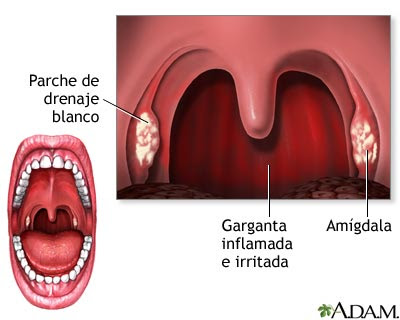
Pharyngitis is the commonest cause of simple "sore throat". It may be due to infective or other causes. Viral infections include coryza, influenza, adenovirus, herpes simplex, measles, rubella, chickenpox, Coxsackie and echoviruses. Bacterial pathogens such as streptococci, Staphylococci, Penumococci, H. Influenzae, C. diphtheriae, fusobacterium, gonococci and T. Pallidum and fungi such as Candida albicans may lead to pharyngitis. In agranulocytosis and acute leukemia, necrotic ulceration of the tonsils and pharynx may be the presenting symptom. Excessive smoking, noxious fumes, corrosive and unaccustomed spicy foods are common irritants. Pharyngitis may also be caused by allergy to inhaled or ingested allergens.


Nursing Diagnosis for Pharyngitis

1. Acute pain related to inflammation of the throat.

2. Ineffective airway clearance related to thick secretions characterized by difficulty in breathing.

3. Imbalance nutrition less than body requirements related to difficulty swallowing.

4. Knowledge Deficit related to not familiar with the sources of information.

Pathophysiology of Pharyngitis

Pathophysiology of Pharyngitis

Pathophysiology of Pharyngitis

Transmission is by droplet. Germs infiltrate the epithelial layer, then the epithelium is eroded, then the superficial lymphoid tissue inflammatory reaction occurs with the damming of polymorphonuclear leukocyte infiltration. In the early stages there is hyperemia and edema and increased secretions. Serous exudate at first, but tends to become thickened and dry and can be attached to the pharyngeal wall. By hyperemia, blood vessel walls of the pharynx to the width. Blockage forms a yellow, white, or gray present in follicles or lymphoid tissue. It appears that the lymphoid follicles and blotches on the posterior pharyngeal wall or located more laterally to become inflamed and swollen causing inflammation of the throat or pharyngitis.

NCP Stroke: Ineffective Cerebral Tissue Perfusion related to interruption of blood flow

NCP Stroke: Ineffective Cerebral Tissue Perfusion related to interruption of blood flow

NCP Stroke: Ineffective Cerebral Tissue Perfusion related to interruption of blood flow

Ineffective Cerebral Tissue Perfusion related to interruption of blood flow: occlusive disease, hemorrhage, cerebral vascular spasm, cerebral edema.

Expected outcomes are:
  • Maintained and increased the level of consciousness, cognition and function of sensory / motor.
  • Reveals stabilization of vital signs and no increase in intracranial pressure.
  • The role of the patient reveals no deterioration / recurrence.

Nursing Intervention:

Independent
  • Determine the factors related to individual situations / causes of coma / decreased cerebral perfusion and a potential increase in intracranial pressure.
  • Monitor and record neurological status on a regular basis.
  • Monitor vital signs.
  • Pupil evaluation (size, shape similarity and reaction to light).
  • Help to change the view, misalnay blurred vision, visual field changes / perceptual field of view.
  • Increasing auxiliary functions, including speech if the patient has impaired function.
  • And gradual elevation of the head in neutral position.
  • Maintain bed rest, provide a quiet environment, set visits as indicated.
  • Provide supplemental oxygen as indicated.
  • Give medications as indicated.

Medical Management of Scoliosis

Medical Management of Scoliosis

Medical Management of Scoliosis

Treatment depends on the cause, degree and location of the curve and the stage of bone growth.

If the curvature is less than 20%, usually require no treatment, but patients should perform regular checks every 6 months.

In children who are still growing, the curvature usually increased up to 25-30%, because it is usually advisable to use braces to help slow the progression of the curvature of the spine.

Braces of the "Milwaukee and Boston" is effective in controlling the progression of scoliosis, but must be installed for 23 hours / day until the child stops growing.
Brace ineffective in congenital and neuromuscular scoliosis.

If the curvature reached 40% or more, usually with surgery. In the surgery done to improve the curvature and fusion of the bones. Bone is maintained in place with the help of 1-2 metal tool attached to the bones recovered (less than 20 years). After the surgery may need to be fitted brace to stabilize the spine.

Sometimes given elektrospinal stimulation, in which the spinal muscles were stimulated with a low electrical current to straighten the spine.

Pathophysiology of Scoliosis

Pathophysiology of Scoliosis

Pathophysiology of Scoliosis

Deformity of the spine called scoliosis, originated from the nerves of weak or even paralyzed attractive segments of the spine. This serves to keep the pull of the vertebrae are in the normal lines of its shape like a ruler or straight. But for some reason, such as the habit of sitting the oblique, make the most of the work to be weak nerves. If this continues over and over becomes a habit, then the nerve will even die. This results in an imbalance of pull on the vertebrae. Therefore, suffering from scoliosis of the spine is curved like the letter or the letter S or C.

Nursing Assessment for Scoliosis

Nursing Assessment for Scoliosis

Nursing Care Plan for Scoliosis : Nursing Assessment for Scoliosis

The physical examination includes:

a. Assessing the body's skeletal
The presence of deformity and alignment. Abnormal bone growth due to bone tumors. Shortening of the extremities, amputation and body parts that are not in anatomic alignment. Abnormal angulation of the long bones or motion at a point other than the joints usually indicate a fracture.

b. Assessing the spine
Scoliosis (lateral curvature of the spine deviation)

c. Assessing the joint system
Extensive movement are evaluated either actively or passively, deformity, stability, and bruising, stiffness of joints.

d. Assessing the muscle system
The ability to change position, muscle strength and coordination, and the size of each limb to mementau otot.Lingkar edema or atropfi, muscle pain.

e. Examine how to walk
The existence of irregular movements are not considered normal. If one limb shorter than the others. A variety of neurological conditions associated with abnormal gait (eg walking spastic hemiparesis - stroke, how to go step by step - lower motor neuron disease, how to walk vibrate - Parkinson's disease).

f. Examine the skin and peripheral circulation
Palpation of the skin may indicate a yanglebih temperature hotter or colder than others and adanyaedema. Peripheral circulation was evaluated by assessing peripheral pulses, color, temperature and capillary refill time.

Analysis of data
Subjektif Data :
  • Back pain patients say
  • Patients said fatigue in the spine after sitting or standing for long
  • Patients say trouble breathing

Objective Data :
  • That looks are not the same shoulder height
  • Visible protrusion of the scapula is not the same
  • Looks are not the same hip
Copyright © Nursing Diagnosis Intervention. All rights reserved. Template by CB | Published By Kaizen Template | GWFL | KThemes